Commercial heat pumps are moving from niche equipment to core building infrastructure. The International Energy Agency reports that global heat pump sales grew by 11% in 2022, despite supply-chain pressure. That growth makes electrical planning more important for offices, schools, retail sites, and warehouses.
So, what are the electricity requirements for a commercial heat pump? The answer depends on heating capacity, compressor type, outdoor temperature, voltage, phase, and auxiliary heat. A small rooftop unit may use 208 or 230 volts, while larger systems often require three-phase power at 460 or 480 volts. The equipment nameplate remains decisive. It lists minimum circuit ampacity, maximum overcurrent protection, and rated load conditions.
Small details matter.
The 2026 design process should align with the adopted National Electrical Code, local amendments, and applicable ASHRAE standards. NEC Article 440 commonly guides air-conditioning and refrigeration equipment, while ASHRAE 90.1 addresses commercial energy performance. The U.S. Department of Energy also emphasizes controls, demand management, and efficient HVAC operation in commercial buildings. These requirements affect feeder sizing, disconnect locations, grounding, short-circuit protection, and building automation connections.
A practical review should begin with the manufacturer’s submittal, not a generic online table. Measure panel capacity, conductor length, voltage drop, and available fault current. Then confirm startup current and electric resistance backup demand. Some early designs underestimate winter peak loads. That mistake can create nuisance trips or expensive service upgrades. Local inspection feedback can also change the final configuration, so this guide should support engineering judgment rather than replace it.
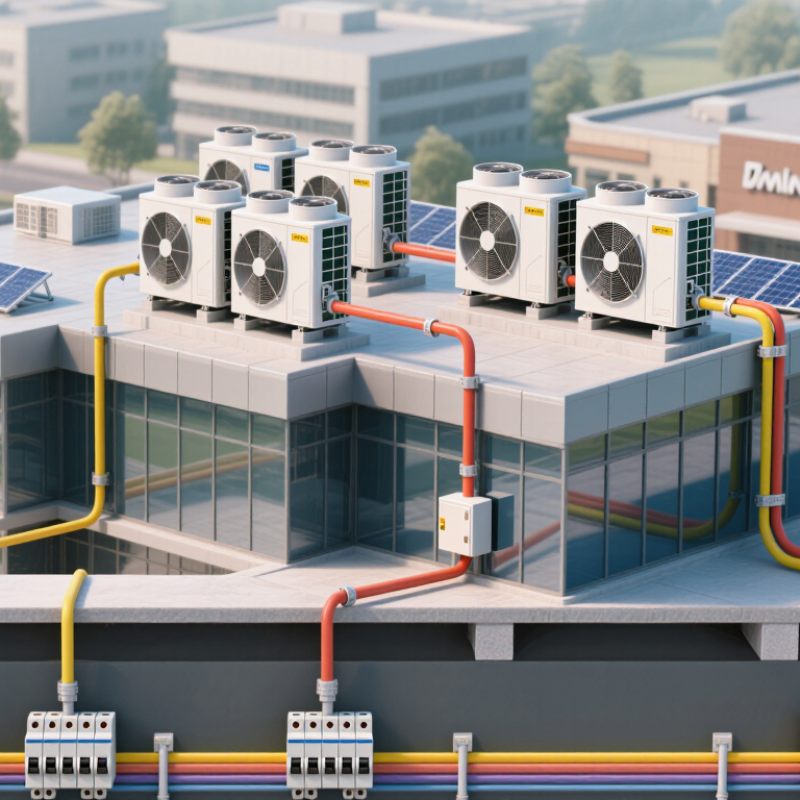
Commercial Heat Pump Electrical Requirements for 2026
Commercial heat pump electrical requirements depend on equipment capacity, climate, and building loads. Start with the unit’s nameplate: verify voltage, phase, minimum circuit ampacity, and maximum overcurrent protection. A 208/230-volt, three-phase unit needs a different supply arrangement from a single-phase model. Do not size wiring from nominal tonnage alone. The U.S. Department of Energy explains that heat pumps can deliver multiple units of heat per unit of electricity, but that efficiency does not remove the need to check peak electrical demand.
Have a qualified electrical professional calculate the building load under applicable local codes and the selected equipment’s installation instructions. Include compressors, fans, controls, defrost operation, and any electric resistance backup heat. That backup can sharply raise demand on cold mornings. Check panel capacity, feeder and disconnect ratings, conductor sizing, grounding, and available fault current; coordinate these with the mechanical design before procurement. IEA’s 2022 report, The Future of Heat Pumps, notes that heat pumps are typically three to five times more energy-efficient than fossil-fuel boilers. Still, actual site performance varies.
Leave room for commissioning. Measure voltage and current under operating conditions, then confirm protection devices match the manufacturer’s specifications. A tidy nameplate review helps, but it cannot replace a site load calculation. Plans do miss things—especially when older panels or future tenant loads are involved.
| Electrical Requirement | What to Check | Practical Guidance for 2026 |
|---|---|---|
| Applicable electrical code | Locally adopted code edition, amendments, and permit requirements | There is no single nationwide 2026 requirement. Confirm the adopted edition and local rules with the authority having jurisdiction (AHJ) before design or installation. |
| Supply voltage and phase | Equipment nameplate and manufacturer’s installation instructions | Commercial equipment may be designed for different supply configurations, including three-phase power. Verify that the building supply matches the specific unit; do not assume a voltage or phase from capacity alone. |
| Minimum circuit ampacity (MCA) | Unit nameplate or approved manufacturer documentation | Use the listed MCA when sizing branch-circuit conductors, subject to applicable code rules. Do not substitute a general ampacity estimate for the equipment-specific value. |
| Maximum overcurrent protection (MOCP) | Unit nameplate or approved manufacturer documentation | Select a fuse or circuit breaker that does not exceed the marked maximum and meets the manufacturer’s specified type and installation requirements. |
| Branch-circuit conductors | MCA, conductor material, insulation rating, installation conditions, and terminal temperature limits | Size conductors in accordance with the adopted electrical code and equipment instructions. Account for ambient temperature, bundling, raceway conditions, and other applicable correction factors. |
| Disconnecting means | Location, accessibility, rating, and visibility from the equipment | Provide a code-compliant disconnecting means where required. Follow the applicable rules for HVAC equipment and the manufacturer’s instructions; the required arrangement depends on the installation and jurisdiction. |
| Grounding and bonding | Equipment grounding conductor, bonding path, and electrical connections | Provide grounding and bonding in accordance with the adopted code and the unit’s installation instructions. A grounding conductor is not a substitute for a current-carrying circuit conductor. |
| Short-circuit and ground-fault protection | Marked MOCP, circuit design, available fault current, and protective-device ratings | Coordinate the protective device with the equipment markings and the applicable HVAC and general overcurrent-protection rules. Confirm that the device is suitable for the available fault current. |
| Electric resistance backup heat | Heater kit rating, staging, MCA, MOCP, and required circuit arrangement | Auxiliary or supplemental electric heat can substantially change the electrical load. Use the data for the exact heat-pump and heater combination; do not size circuits from compressor data alone. |
| Multiple units and service capacity | Connected loads, demand calculations, feeder capacity, and service capacity | Calculate the building load under the locally adopted code. Consider simultaneous operation, backup heat, other HVAC loads, and any applicable demand-control strategy. |
| Controls and low-voltage wiring | Control voltage, wiring diagram, separation, and field-installed accessories | Follow the equipment wiring diagram for control and communication circuits. Keep wiring types and routing compliant with applicable code requirements and the manufacturer’s instructions. |
| Commissioning and inspection | Permit sign-off, electrical connections, protective devices, and operational checks | Have the installation inspected where required. Verify supply characteristics, connections, protective-device ratings, and operation against the approved submittal and equipment documentation. |
Requirements are equipment- and jurisdiction-specific. The unit nameplate, manufacturer’s installation instructions, approved project documents, and locally adopted electrical code govern the final design and installation.
Photograph each equipment label. Record voltage, phase, minimum circuit ampacity, and maximum overcurrent protection. Include fans, pumps, controls, and backup heaters.
Not reliably. Operating conditions and applicable demand factors can change the calculation. A qualified electrical professional should review the actual equipment schedule.
It helps guide conductor sizing. Check conductor ratings, terminal limits, installation conditions, and local requirements before choosing wiring.
It sets the equipment’s upper limit for circuit protection. A larger breaker is not a fix for repeated trips.
Confirm available breaker spaces, feeder capacity, grounding, and fault current. A crowded panel can make an otherwise simple plan harder.
Long wiring routes may cause voltage drop, especially during startup. Measure the actual route, not just the straight-line distance.
Keep it accessible near the equipment, subject to adopted code and local requirements. Avoid locations blocked by piping or roof access paths.
Not necessarily. Verify each unit’s label and installation conditions. Rooftop conduit in direct sun may affect conductor ampacity.
Check whether compressors may start together and whether defrost or backup heat could run during cold weather. Peak demand can surprise you.
This article explains what are the electricity requirements for a commercial heat pump and how to plan a safe, reliable electrical installation for 2026. It covers estimating equipment loads, assessing available power capacity, and coordinating electrical supply with expected heating and cooling demand. It also outlines how circuit protection, correctly rated disconnects, and appropriately sized wiring support dependable operation while helping prevent electrical hazards.
The guide further explores three-phase power, control-system connections, and backup power considerations where continuity is important. It highlights the need to verify applicable electrical codes, energy-efficiency requirements, and inspection procedures before installation. By addressing these factors early, building owners and project teams can better coordinate equipment selection, electrical design, commissioning, and ongoing compliance.

 PeakWay Pump